Scorpions, spiders & other arachnids.
Not reptiles or amphibians, but they share the same nocturnal-dry-forest niche — and one group is the most medically significant venomous animal you will share space with at Saladita on a daily basis. The scorpions are in every house; the tarantulas are in every hillside burrow. Worth knowing on sight.
Centruroides bark scorpions are in every structure at Saladita
Centruroides limpidus (and related species) are the dominant scorpion of coastal Guerrero. They live inside houses, behind furniture, under rocks, and in palm thatch. Their sting causes immediate, intense burning pain. In healthy adults it is rarely life-threatening; children under 10, adults over 65, and anyone with a heart condition face higher risk and should go directly to a clinic.
Standard precautions:
If stung: Wash the site, apply a cold pack for pain. Clinic visit is warranted for any child, elderly person, or if systemic symptoms develop (difficulty swallowing, blurred vision, muscle twitching). Antivenom is Alacramyn (BIOCLON/Rare Disease), available at IMSS and major pharmacies in Zihuatanejo (~35 km). For healthy adults: most stings resolve in 2–8 hours with pain management alone.
Scorpions — Order Scorpiones
Three Centruroides bark scorpions are documented or strongly expected on the Guerrero Pacific slope. All three are medically relevant. A large Diplocentrus species is also present but less dangerous. Bark scorpions fluoresce blue-green under UV; the large forest scorpions fluoresce dull green or not at all.
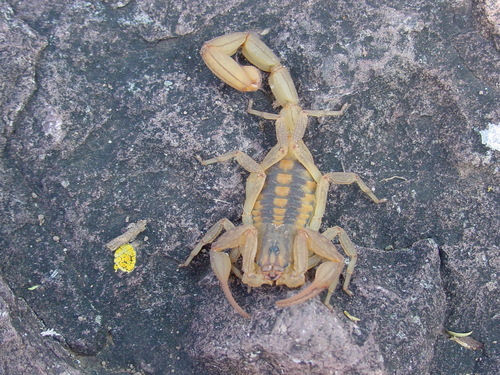
Mexican Bark Scorpion
The dominant scorpion of coastal Guerrero and most of western Mexico. Small (4–6 cm), straw to pale yellow, slender pincers, thin segmented tail with a fine curved stinger at the tip. Nocturnal; shelters by day under bark, rocks, debris, and inside wall gaps. Sting causes intense burning pain; neurotoxic venom. Glows vivid blue-green under UV.
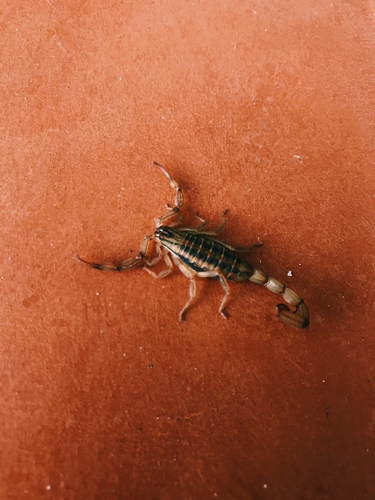
Sinaloan Bark Scorpion
Closely related to C. limpidus; slightly more slender and often with a darker stripe running the length of the metasoma. Distributed across the Mexican Pacific slope dry forest including Guerrero. Behaviorally and ecologically nearly identical to C. limpidus; treat any pale, thin-tailed scorpion in this region as medically relevant.
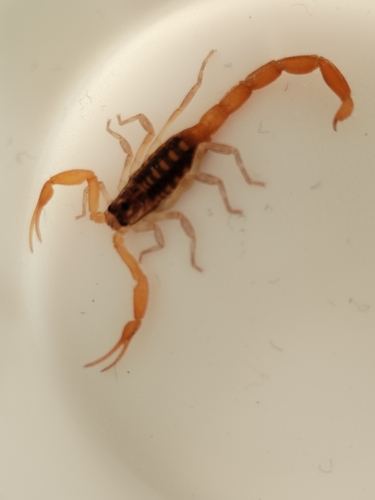
Durango Bark Scorpion
Primarily a northern-Mexico species (Durango, Sinaloa, Chihuahua) but documented in the literature for parts of Guerrero and the Pacific corridor. Heavier-bodied than C. limpidus; variable brown-tan coloration. Envenomation profile similar across the genus — intense pain, possible autonomic symptoms. Field ID of Centruroides species requires microscopy; treat all small bark scorpions identically.
Forest Giant Scorpions
Stout, dark brown-to-black scorpions reaching 8–10 cm — much larger than the Centruroides bark scorpions and more alarming on sight. Diplocentrus belongs to a different family (Diplocentridae) with venom that is considerably less potent than Centruroides; stings are painful but rarely produce systemic symptoms in healthy adults. Found on rocky hillsides and in dry forest leaf litter. Does not enter houses as readily as bark scorpions.
Spiders — medically significant species
Two widow spiders and the brown recluse complex are present at Saladita. Both are genuinely present in Guerrero; bites are uncommon but real. Neither is aggressive.
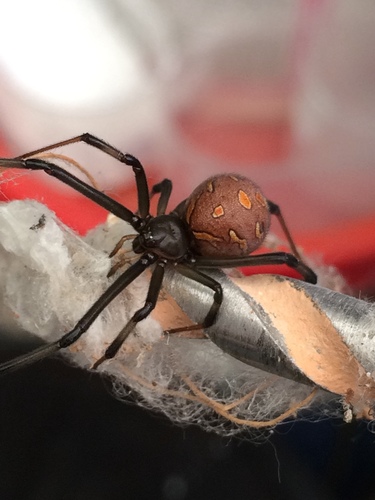
Brown Widow
Tan-to-brown body with a geometric orange hourglass on the underside — less vivid than a black widow’s red. More common at Saladita than the black widow because it colonizes human structures readily. Egg sacs are distinctive: spiky, cream-colored, like a small sea mine. Venom is neurotoxic but generally considered less potent than L. mactans; bites cause local pain and possible mild systemic symptoms. Not typically life-threatening in healthy adults, but a clinic visit is reasonable.
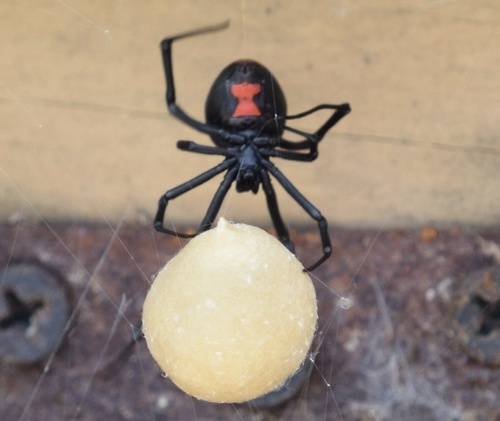
Black Widow
Shiny black, ~1.5 cm body, bright red hourglass on the underside. Less commonly encountered than the brown widow at Saladita but present in the region. Builds tangled, irregular webs in dark undisturbed corners — palapa rafters, behind wood boards, outdoor storage. Bite delivers α-latrotoxin, causing immediate pain followed by muscle cramps and systemic effects. Clinic visit warranted; anti-latrodectus serum is available at major hospitals.
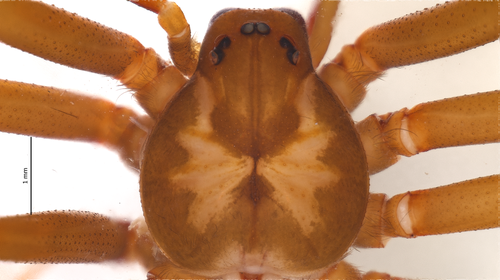
Mexican Brown Recluse
Small (body 6–9 mm), pale tan with a faint violin-shaped marking on the cephalothorax — though this mark is hard to see in the field. Six eyes in three pairs (most spiders have eight eyes in different arrangements) — but you won’t be counting eyes. The key is context: small, pale-tan, found in undisturbed dark spaces. Bite is initially painless or mild; necrotic skin lesion can develop over days in some individuals. Bites are uncommon but documented in Mexico.
Tarantulas — Family Theraphosidae
Two Brachypelma tarantulas are documented on the Guerrero Pacific slope. Both are CITES II protected — do not collect or disturb burrows. They are not medically dangerous to humans but urticating abdominal hairs cause skin and eye irritation.
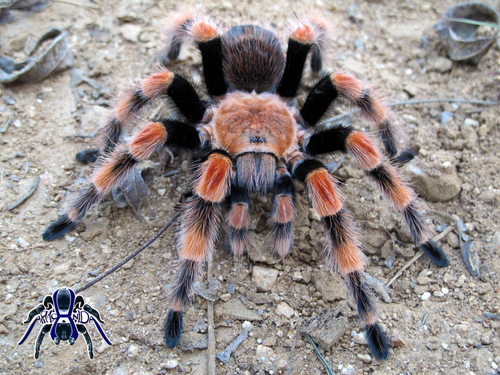
Mexican Red-knee Tarantula
The iconic Mexican tarantula — dark body with bright orange-red leg joints, legspan up to 14 cm. One of the most recognizable spiders in the world. Not medically dangerous. Bite is like a bee sting; the real irritant is urticating hairs flicked from the abdomen when threatened (avoid rubbing eyes if you handle one). Females live 20–30 years and rarely leave their burrows. Wandering males in Sep–Nov are seeking females; this is when you’re most likely to see one crossing a road at dusk.
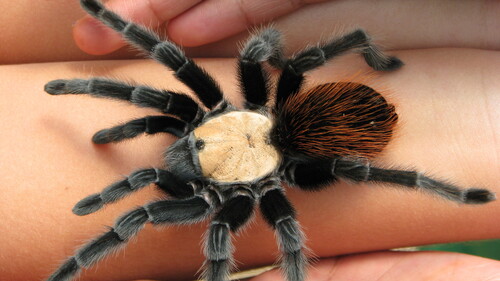
Mexican Golden Red-rump Tarantula
Slightly smaller than B. smithi; pale cream cephalothorax, dark legs with orange-red rump patch. Found on the Mexican Pacific slope including Guerrero dry forest. Same ecology as the red-knee: burrow-dwelling, long-lived females, wandering males in autumn. Same urticating-hair caution applies. Occasionally encountered on paths and roadsides at dusk during male-wandering season.
Common harmless spiders
These species are abundant and visible around any structure, garden, or beach-side vegetation. None are medically significant.
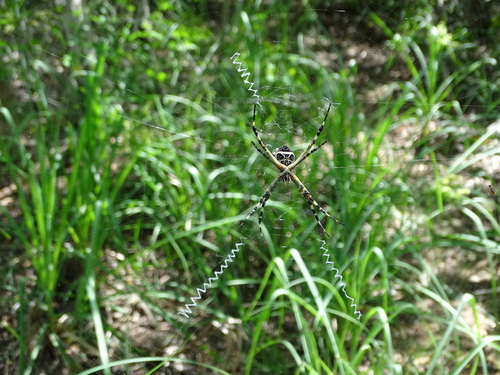
Silver Garden Spider
One of the most visually striking spiders in the region — silver-and-black abdomen, long patterned legs, legspan up to 6 cm. Builds large, conspicuous vertical orb webs with a bold zigzag silk stabilimentum down the center. Hangs head-down in the web’s center in sunlight. Common in gardens, beach-side vegetation, and between palapa structures. Bite is negligible; venom weak. The stabilimentum (the thick zigzag) is thought to make the web more visible to birds, reducing destruction.
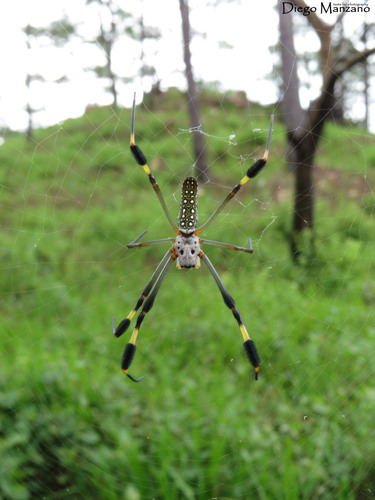
Golden Silk Orb-weaver
Formerly Nephila clavipes. One of the largest orb-weavers in the Americas — female body 4–5 cm, with long tufted legs and an elongated golden-orange abdomen. Builds enormous webs (up to 1.5 m diameter) with silk that is visibly golden-yellow in sunlight — the silk is among the strongest biological materials known. Often builds webs across forest paths. Males are tiny (6 mm) and often sit at the edge of the female’s web. Harmless.
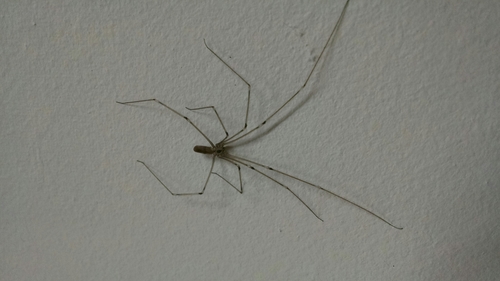
Daddy Long-legs Spider
Extremely long thin legs, small pale body — builds loose, irregular webs in corners of every palapa and interior space. When disturbed it vibrates the web so rapidly it becomes a blur (a defensive display). Found in every building at Saladita. The idea that its venom is highly toxic but its fangs are too short to bite humans is a persistent myth — it can bite, and its venom is not remarkable. Ecologically useful: eats mosquitoes, small moths, and other house spiders including widows.
Wolf Spiders & Jumping Spiders
Wolf spiders (Lycosidae) are large, hairy, brown ground-hunting spiders — the ones you see running fast across open ground at night. Females carry egg sacs and then hatchlings on their backs. Bite is possible if picked up but not medically significant. Jumping spiders (Salticidae) are small, chunky, diurnal spiders with large front eyes that track your movement as they face you. Many Guerrero jumping spiders have iridescent or brightly colored markings. Neither group is medically relevant.
Crab Spiders
Sideways-walking, ambush spiders that sit motionless inside flowers, waiting for pollinators. Many species can change color to match white or yellow flowers over several days. Front two pairs of legs held wide like a crab’s claws. Common in the flowering scrub around Saladita, especially on beach morning glory and dry-forest shrubs in bloom. Harmless to humans.
Other arachnids — named "scorpion" but aren't true scorpions
Three additional arachnid orders here have "scorpion" or "whip" in their common names but are not in Order Scorpiones — they are vinegaroons (Order Uropygi), whip-spiders (Order Amblypygi), and sun spiders (Order Solifugae). All are non-venomous and harmless to humans despite the alarming common names and appearance.
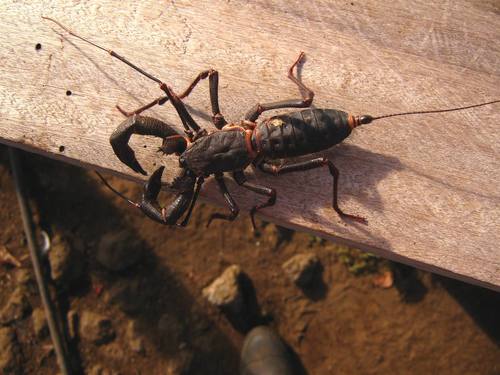
Vinegaroon (not a true scorpion)
Large (body 4–8 cm), shiny dark brown-black, crab-like with heavy front pedipalps used to grab prey and a long thin whip-like tail (the telson) that sprays acetic acid (vinegar) when threatened — hence “vinegaroon.” Not venomous; the spray is mildly irritating but not dangerous. One of the most dramatic-looking arachnids in the dry forest. Nocturnal; hides in burrows and rock crevices by day. Preys on large insects, millipedes, and small vertebrates.
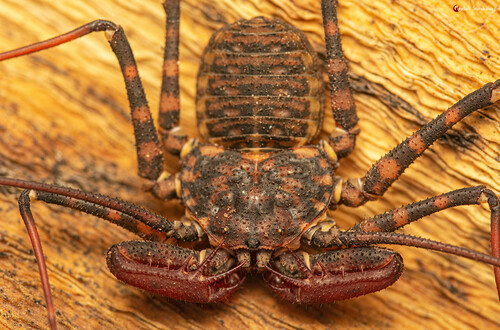
Whip-Spider (not a true scorpion or spider)
Flat, dark, crab-shaped body with two enormously long front legs used as sensory whips — these can span 20 cm or more. Absolutely terrifying to find on a wall. Completely harmless: no venom, no stinger, no spray. The whip-legs are touch-and-vibration sensors, not weapons. Active at night on stone walls, rock faces, and cave entrances. Preys on cockroaches and other large insects. If found indoors: leave it — it is an effective roach predator. If you must remove it, use a cloth or container and release outside.
Sun Spiders / Wind Scorpions
Not spiders, not scorpions — a separate order entirely. Fast-moving, hairy, pale-tan to orange, with enormous chelicerae (jaws) nearly the size of their cephalothorax. Look like a small furry spider moving at sprint speed across open ground. Found in dry, open habitats at the dry-forest margins. No venom glands — they are not chemically dangerous — but the chelicerae can cause a mechanical bite wound if handled carelessly. Rarely encountered in the immediate coastal zone; more common in drier interior terrain.
UV flashlights (sold in any hardware store; 365 nm wavelength works best) are the single best arachnid field tool at Saladita. Centruroides scorpions glow vivid blue-green; run one along any outdoor wall after dark to calibrate your sense of how present they actually are. Most visitors are surprised by the count on their first night.